
A maximum is not a selection
A product family can span hundreds of frame and ratio combinations. Its largest published torque value tells you the scale of the range; it does not tell you what a smaller unit can deliver. Start your shortlist with the operating point: output speed, continuous load, acceleration demand, starts per hour and installation envelope. Then ask each manufacturer to propose a complete configuration. This turns a comparison of marketing numbers into a comparison of documented choices.
Can the two maxima ever coincide?
Sometimes they can, if the manufacturer documents that exact combination. The mistake is assuming that they must. A family range is an envelope across sizes, stages and options. Record the complete product code alongside the selected ratio, continuous output torque, input speed and duty. Ask for confirmation of that row, rather than asking whether the catalog contains both numbers somewhere.
The catalog example that changes the comparison
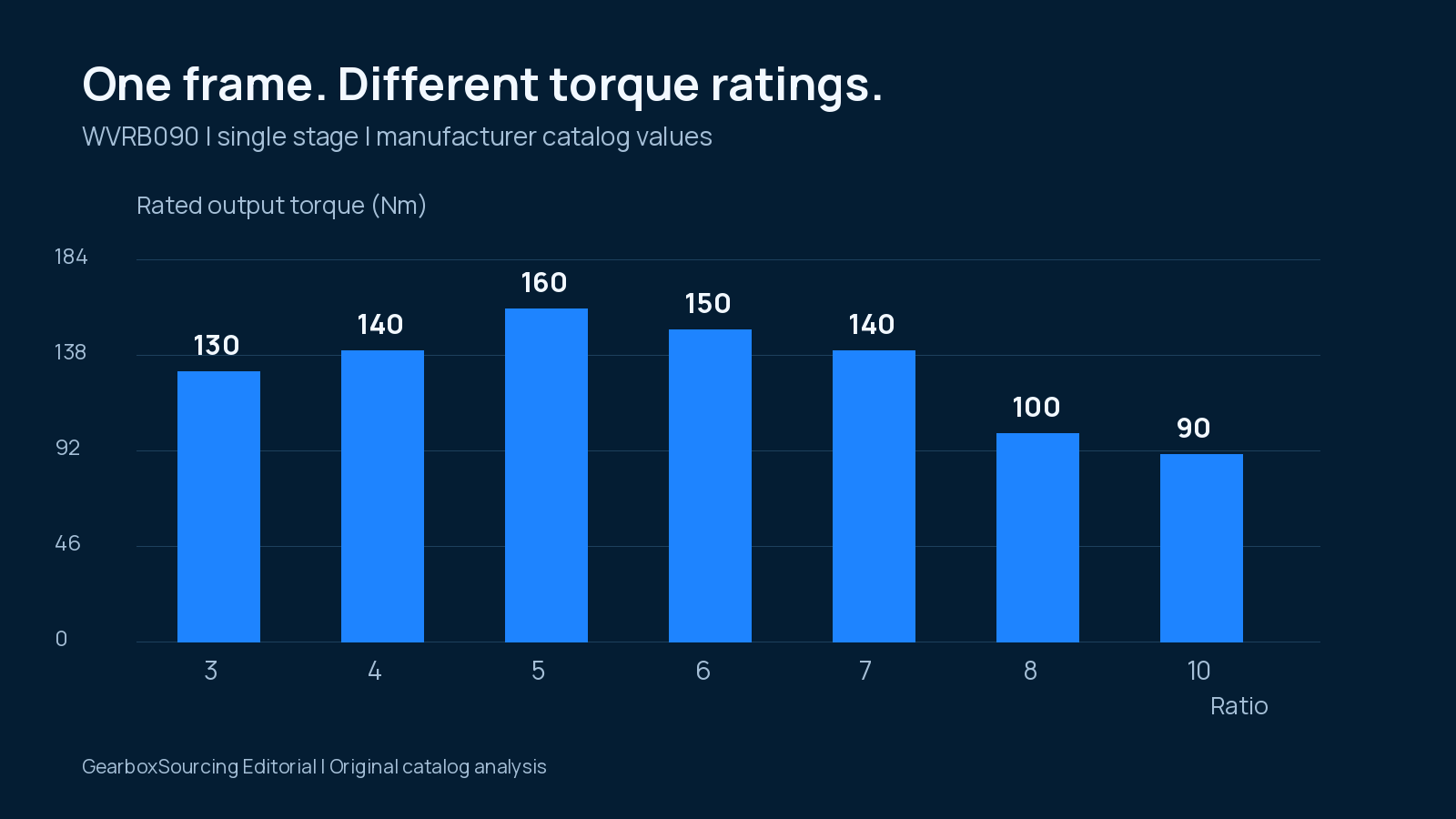
WANSHSIN’s WVRB table gives a useful illustration. At a single-stage ratio of 5, the WVRB090 frame is rated at 160 Nm. At ratio 10, the same frame is rated at 90 Nm. A higher reduction ratio therefore does not automatically mean a higher catalog torque rating. The two entries belong to the same frame family but are different operating selections. Our product table keeps their ratios and rated torques paired, rather than combining a family maximum with a convenient ratio.
Separate the load cases
Write down normal running torque, repeated acceleration and deceleration, and the exceptional load expected during an emergency stop. Keep duration and repetition with each value. A momentary allowance is not a continuous rating. If the driven equipment can jam, reverse rapidly or receive external impacts, describe those events instead of hiding them inside a single safety multiplier. Ask the supplier to state the service factor and load assumptions used in its selection calculation.
Check speed and heat before approving the frame
Input speed, duty and ambient temperature influence the selection. A unit that can transmit the torque mechanically may still need a thermal check in continuous operation. Tell the supplier how long the machine runs, whether the housing receives airflow and whether the motor starts frequently. Do not use the maximum input speed as the normal operating speed unless the catalog explicitly supports that duty. The lubricant and mounting position should be included in the thermal discussion.
Treat the interface as part of the product
Record the motor shaft diameter, shaft length, flange register, bolt pattern and keyway or clamping arrangement. On the output side, include overhung load, axial load and the distance between the load and the gearbox face. Two units with the same ratio can require different couplings, mounting brackets or bearing arrangements. Request a dimensioned drawing and check it against the machine, not just against a competitor’s product name.
What a useful quotation contains
Ask for the exact order code, ratio, precision grade, rated and peak load limits, mounting position, lubricant, drawing revision and delivery scope. State whether the motor, coupling and brake are included. Keep an acceptance checklist alongside the quotation: interfaces checked, load calculation received, operating conditions confirmed and maintenance instructions available. This is a purchasing workflow, not a substitute for application engineering; the manufacturer must confirm suitability for the actual machine.
Gearbox types and documented products in this guide
Planetary Gearboxes
- TST Precision Planetary Gear Reducer · TECHMECH
- TF Precision Planetary Gear Reducer · TECHMECH
- SG-PG28 28 mm Metal Planetary Gearbox · SIGGEAR
Helical Gearboxes
- ER Helical Geared Reducers · EVERGEAR
- MTH Heavy-Duty Helical Gearbox · TANHON
- RX Single-Stage Helical Gear Units · SEW-EURODRIVE Tianjin
Worm Gearboxes
- FCNDK-B5 Worm Reducer · FIXEDSTAR / Hangzhou Zhongde
- WMRV Worm Gear Reducers · WUMA
- JDLB Precision Duplex Worm Reducer · JIAOXING
Bevel Gearboxes
- JHG Helical-Hypoid Gear Reducer · JIAOXING
- K Series Helical-Bevel Geared Motor · Feluoka Heavy Industry Transmission
- K Series Helical-Bevel Geared Motor · Tunsing Transmission
Cycloidal Reducers
- CORT-20E Precision Cycloidal Reducer · Hengfengtai
- ZKRV-20E Precision Cycloidal Reducer · Nantong Zhenkang
- BW / BWY / XW / XWY Cycloidal Pinwheel Reducers · Xinghai Reducer
Harmonic Reducers
Continue reading
Planetary vs worm gearbox: compare the machine, not just the ratio →
Planetary gearbox backlash: what ≤3 arcmin means for a servo axis →
How to verify gear heat treatment before placing a gearbox order →
 LinkedIn
 X
 Facebook
 WhatsApp
 Telegram
 Reddit
 Email