
Start with the drawing, not a universal hardness target
Ask the supplier to identify the actual gear material, drawing revision and intended heat-treatment route. Carburizing is one option; it is not a universal requirement for every gear architecture or duty. For example, KHK lists SCM415, carburizing and 55–60 HRC for its MSGA/MSGB gears. That published specification differs from the often-quoted 58–62 HRC range. The useful question is whether the supplied part meets its approved design, not whether every vendor repeats the same number.
Request a connected set of records
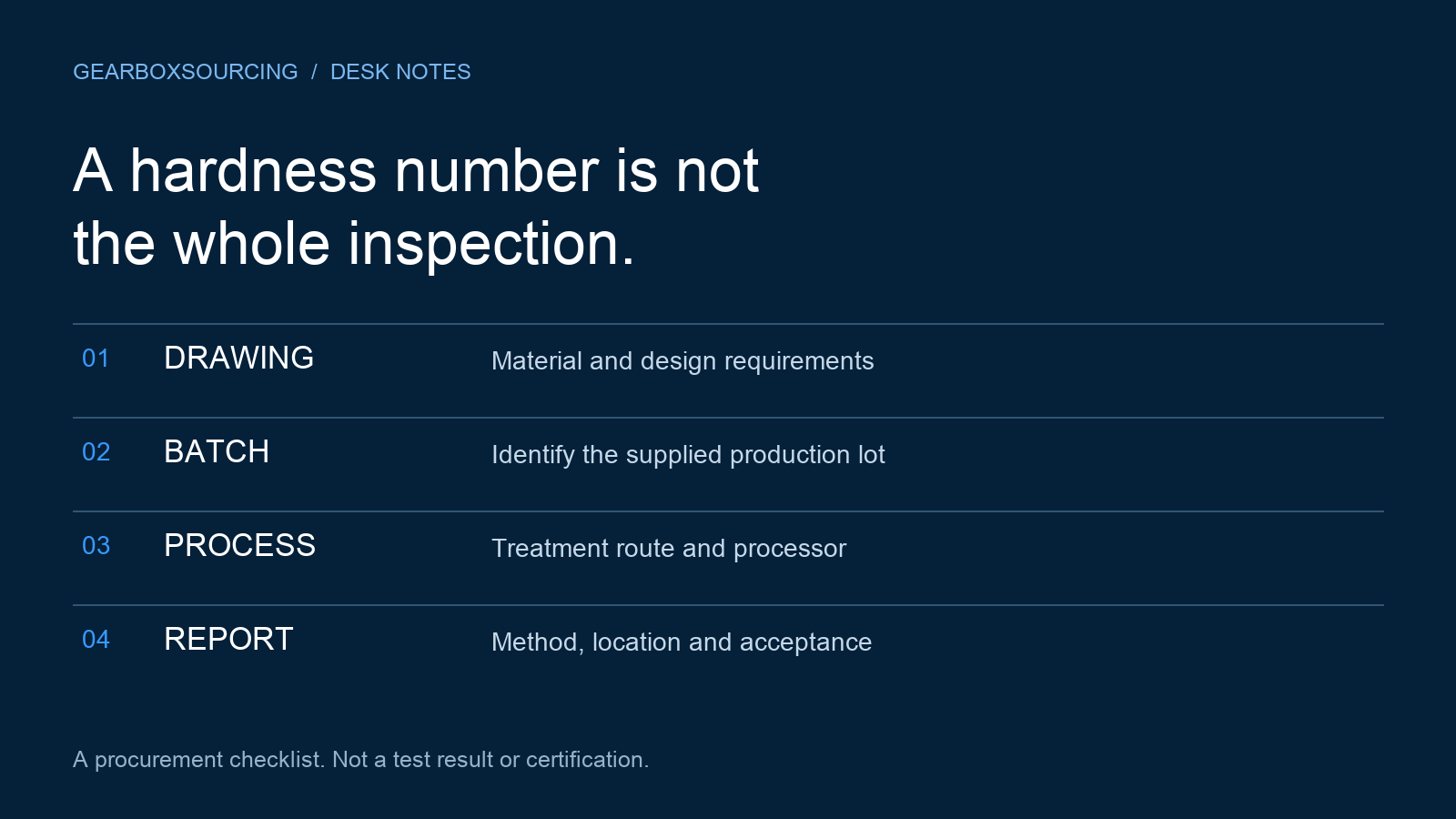
Use four document references in your purchase review: the drawing or agreed specification, the material batch certificate, the heat-treatment batch record, and the inspection report. Ask the supplier to explain how the part or production lot connects to each document. A report from an unrelated sample cannot establish the condition of the goods you are buying. If heat treatment is outsourced, request the processor’s identity and the manufacturer’s acceptance checks. Outsourcing itself is not evidence of poor quality; a missing traceability chain is a reason to investigate.
Read more than the headline HRC value
For a case-hardened gear, ask the responsible engineer to specify which surface is measured, the test method, the acceptance range and the required effective case depth. Ask how core properties are assessed where the drawing requires them. A single surface reading does not describe the entire hardened layer or the core. Do not invent a universal case-depth threshold: the appropriate requirement depends on the material, geometry and design. If the supplier provides a hardness traverse, request the sample location, units and criterion used to derive the reported depth.
Separate a report from a production guarantee
A clean PDF is not a substitute for identifying the inspected batch. Check the part number, revision, lot identifier, test date, instrument or laboratory identification, and approving person. Ask whether the sample was a production part or a witness specimen and why it represents the lot. Resolve discrepancies before accepting the shipment. For a critical application, agree with the supplier on independent testing, sample selection and acceptance criteria before placing the order; destructive testing and ownership of samples should not be improvised after a dispute.
Connect the process to the finished gear
Ask which finishing and dimensional checks occur after heat treatment. The ordered item is a finished gear or gearbox, so an acceptable process report must be considered alongside the final drawing requirements. Request the relevant tooth-accuracy and assembly inspection records, rather than treating hardness as a replacement for them. A gearbox torque rating also depends on its geometry, bearings, lubrication, housing and duty. Neither a heat-treatment certificate nor a high HRC reading alone proves that an assembled unit can transmit a claimed torque continuously.
Put the evidence request in the RFQ
A useful request is specific: “For the offered model and ratio, identify gear material and treatment, provide the applicable hardness and case-depth requirements, explain lot traceability, and list the inspection records supplied with the order.” Add your load cycle, operating speed, environment and expected service life so the manufacturer can propose a suitable design. Ask what is standard documentation and what requires a separately agreed inspection plan. Compare suppliers on whether they answer the same questions, not on how many certificates appear in a brochure.
What should trigger a follow-up?
Pause the technical approval if model identifiers differ between documents, test conditions are missing, or the supplier cannot explain what a certificate actually covers. These gaps call for clarification; they are not proof of fraud. Equally, an unhardened gear is not automatically defective if that is the intended, documented design for its application. This checklist helps organize a purchasing review. It does not replace a gear-design calculation, a qualified metallurgical assessment or acceptance testing agreed for the specific order.
Gearbox types and documented products in this guide
Helical Gearboxes
- MTH Heavy-Duty Helical Gearbox · TANHON
- RX Single-Stage Helical Gear Units · SEW-EURODRIVE Tianjin
- WR Inline Helical Gear Reducers · WUMA
Bevel Gearboxes
- TK Spiral Bevel Gear Reducers · TONGLI
- JHG Helical-Hypoid Gear Reducer · JIAOXING
- K Series Helical-Bevel Geared Motor · Feluoka Heavy Industry Transmission
Planetary Gearboxes
Continue reading
The combined limits trap in gearbox sourcing →
Planetary vs worm gearbox: compare the machine, not just the ratio →
Planetary gearbox backlash: what ≤3 arcmin means for a servo axis →
 LinkedIn
 X
 Facebook
 WhatsApp
 Telegram
 Reddit
 Email