
 Precision motion & process mixing
Hengfengtai
From joint motion to the mixing vessel.
A robot axis and an industrial mixer ask different questions of a transmission. Hengfengtai's portfolio spans CORT precision reducers and engineered mixing assemblies. Start with the motion cycle or the process duty, then define what the manufacturer must supply.
Read one frame, at its actual speed
CORT-20E: 235 Nm at 5 rpm is not 235 Nm at 60 rpm.
The official CORT-E table gives a different output torque at each output speed. For frame 20E, the catalog's rated reference point is 170 Nm at 15 rpm. The slower-speed and faster-speed entries belong to their own operating points.
Source: the official CORT-E rated-data table, pages 2–3 of the displayed catalog images. It defines the rated torque at 15 rpm as the basis for life calculation, except frame 6E, whose reference is 30 rpm. The 6E exception does not change the 20E reference shown here.
Acceleration and exceptional peaks
The 20E continuation separately lists 415 Nm allowable acceleration/deceleration torque and 835 Nm momentary allowable torque. These are not replacement continuous ratings. Agree how the proposed cycle uses these limits and how exceptional stops will be assessed.
Precision and support load
The same 20E row gives 1 arcmin backlash, 50 Nm/arcmin torsional rigidity and 885 Nm allowable moment. Keep torsional rigidity, backlash and the output-support moment as separate checks. Specify the installed load, center of gravity, tool overhang and measurement conditions.
An interface decision
Which member rotates: the shaft or the housing?
The CORT-E catalog provides separate nominal ratios for shaft rotation and housing rotation. The order code alone is not enough unless both parties agree the arrangement.
| CORT-20E shaft-rotation ratio | Corresponding housing-rotation ratio |
|---|---|
| 57 | 56 |
| 81 | 80 |
| 105 | 104 |
| 121 | 120 |
| 141 | 140 |
| 161 | 160 |
These paired entries are transcribed from the 20E row, not combined with another frame's ratios. The catalog designation example CORT–20–E–81–A–B uses the shaft-rotation nominal ratio.
Send a section drawing showing the fixed member, rotating output member and input gear. The designation also identifies input-gear form and output clamping arrangement. Confirm motor/pinion supply, gear tooth data, locating surfaces, bolt pattern, lubrication and assembly tolerances against an approved drawing.
For motor selection, show input speed, required acceleration and the rotating masses. The catalog notes that its inertia entry excludes the input gear shaft portion; include the actual motor, coupling/pinion and payload rather than treating a reducer-only value as the whole axis.
Original designation and paired-ratio table ↗Process equipment
A mixer enquiry begins with the material and vessel.
Hengfengtai's mechanical-mixing page describes top-entry, side-entry, bottom-entry, horizontal and combined layouts. Its design process uses prior application data, design software and laboratory or CFD work. Ask which validation method will be used for your particular material and process target.
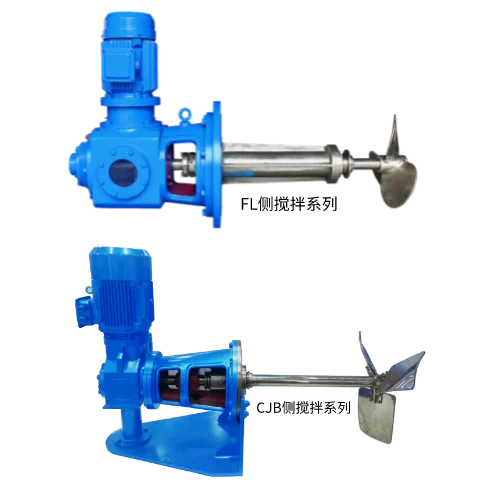
Side-entry: vessel wall, seal and service access
The official application text includes desulfurization towers and large storage tanks. Show the wall connection, liquid level, nozzle angle, solids behavior and available space for the shaft and impeller. Define the process goal: keeping solids suspended, blending stored liquid or another specified task.
The manufacturer describes a service arrangement for maintenance with material retained in the vessel. Ask for the selected unit's isolation/seal design and written maintenance procedure for your liquid, pressure and temperature. Agree shutdown and access requirements with the plant.
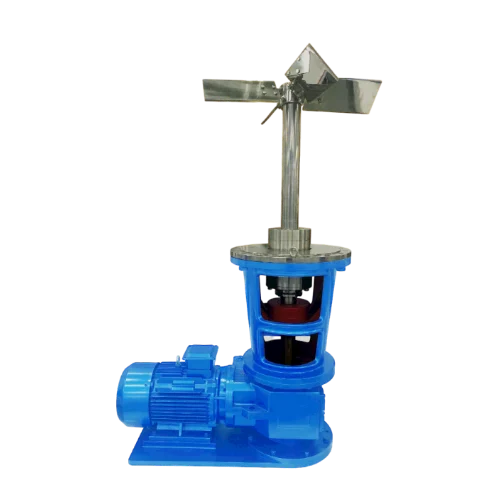
Bottom-entry: restricted headroom and discharge-zone mixing
The published route addresses tall/slender vessels, limited top mounting space and material mixing near the discharge. It describes a shaft seal selected for the material. Send vessel-bottom geometry, outlet/nozzle locations and the required emptying and cleaning sequence.
Provide viscosity across the operating temperature range, density, solids concentration and particle properties. Identify corrosion, abrasion, pressure/vacuum and cleaning requirements so the seal, wetted materials, shaft and impeller can be selected as one assembly.
Define a measurable process result
Include working volume, fluid properties, fill levels, vessel drawing, baffles/coils, impeller clearance and the target result with an acceptance method. Agree mixing time, suspension or other relevant criteria under stated test conditions. The public solution page does not give a universal speed, power or processing capacity for all vessels.
Official mechanical mixing solutions ↗Transmission development alongside process machinery.
Hengfengtai is based in Wenzhou, Zhejiang. Its official history traces the predecessor Ouhai County reducer factory to 1991, a company renaming in 1995 and a CORT precision-reducer trial plant in 2009. The 2024 annual report identifies the present legal entity's establishment date as 22 April 1995; that is distinct from the predecessor's start.
The company overview describes the development of worm and other geared transmissions through to CORT precision reducers. It also covers solar-tracking drives and mechanical mixers. A purchaser should identify the responsible product team and the proposed unit or assembly, rather than treating the entire company portfolio as one interchangeable gearbox range.
For a CORT purchase, request unit-linked dimensional and motion-test records with load and measuring conditions. For mixing equipment, agree the process validation, materials, seal specification and assembled run-test scope. Put deliverables, drawing revision and acceptance criteria into the purchase specification.
Choose your enquiry route.
Tell Hengfengtai whether you need a precision motion component or a complete process-mixing assembly.
Save Hengfengtai to include it in your request.CORT motion component
- Frame, shaft/housing rotation arrangement, ratio and approved interface drawing.
- Output torque/speed/time sequence, reversals, dwell and stop events.
- Payload, overhang, external loads, motor/pinion and required precision test.
Mechanical mixing assembly
- Vessel drawing, working volume, material/rheology and process target.
- Entry layout, seal, wetted materials, temperature/pressure and cleaning.
- Drive/shaft/impeller scope, site access and agreed validation/acceptance.
Sources & review
Reviewed 8 October 2026. CORT values refer specifically to frame 20E and the stated rotation/duty conditions. Process and enquiry questions are editorial guidance.
- Hengfengtai · CORT-E official product page ↗Published catalog images and CORT-E/CORT-C designation information.
- CORT catalog · designation and rated-data table ↗Pages 1–2: 20E paired shaft/housing ratios and output torque at 5–40 rpm; rated reference definition.
- CORT catalog · continuation and duty notes ↗Page 3: 50/60 rpm, backlash, rigidity and transient limits. Note 7 limits the speed entries to forward/reverse use.
- Hengfengtai · mechanical mixing solutions ↗Layout/application descriptions and the side-/bottom-entry images reproduced above.
- Hengfengtai · official English company history ↗Predecessor history, CORT development and transmission/process portfolio.
- Hengfengtai · 2024 annual report, company-authored disclosure ↗Company overview: legal identity, establishment date and Wenzhou contact address. Historical disclosure, not a product performance certificate.
 LinkedIn
 X
 Facebook
 WhatsApp
 Telegram
 Reddit
 Email