
 Strain-wave joint integration
PICEA Motion
Choose what your joint needs to include.
A strain-wave component set leaves different design responsibilities from a hollow assembled reducer. PICEA's PMCG-I-E and PMHG-I frame-20 tables share several torque values, but their supplied structure, mass and interfaces differ. Select the joint architecture before comparing a torque headline.
Decide the joint architecture
Where does the reducer end and your mechanism begin?
The PMCG page identifies a cup-type flexspline, circular spline and wave generator. The PMHG page describes a flanged hollow flexspline, a central bore through the wave-generator cam, internal support bearings and an enclosed assembly.
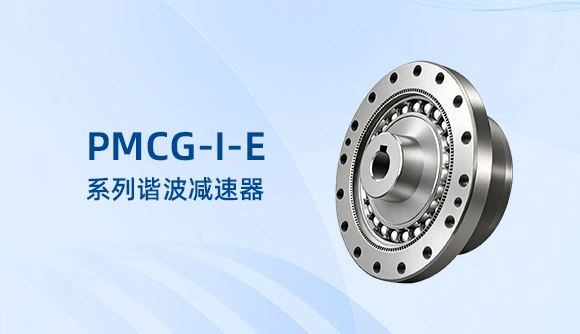
PMCG-I-E · integrate the component set
The input shaft fits the wave-generator bore using a key or set-screw connection described by PICEA. Define your housing, supporting arrangement, locating surfaces, alignment, fasteners, sealing and lubrication with the supplier.
The published frame-20 mass is 0.26 kg. It is the component-set figure, not the mass of a complete motorized joint or your surrounding support structure.
PMCG-I-E 20 directory specifications →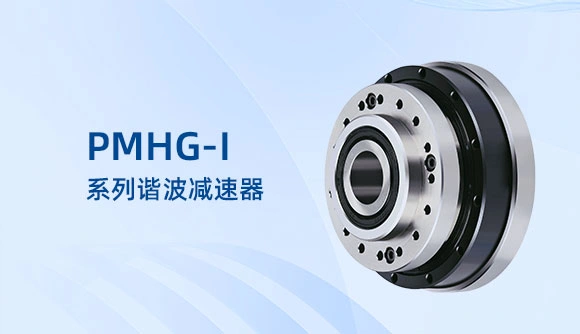
PMHG-I · preserve the hollow passage
The assembly is intended for installations requiring cables or air lines through the reducer centre. Verify the usable bore throughout the motor, coupling, reducer and driven mechanism, along with routing and assembly access.
The published frame-20 mass is 1.38 kg. Internal support bearings do not remove the need to check output moment, radial/axial load and the joint's support arrangement.
PMHG-I 20 directory specifications →Frame 20: keep each torque condition separate.
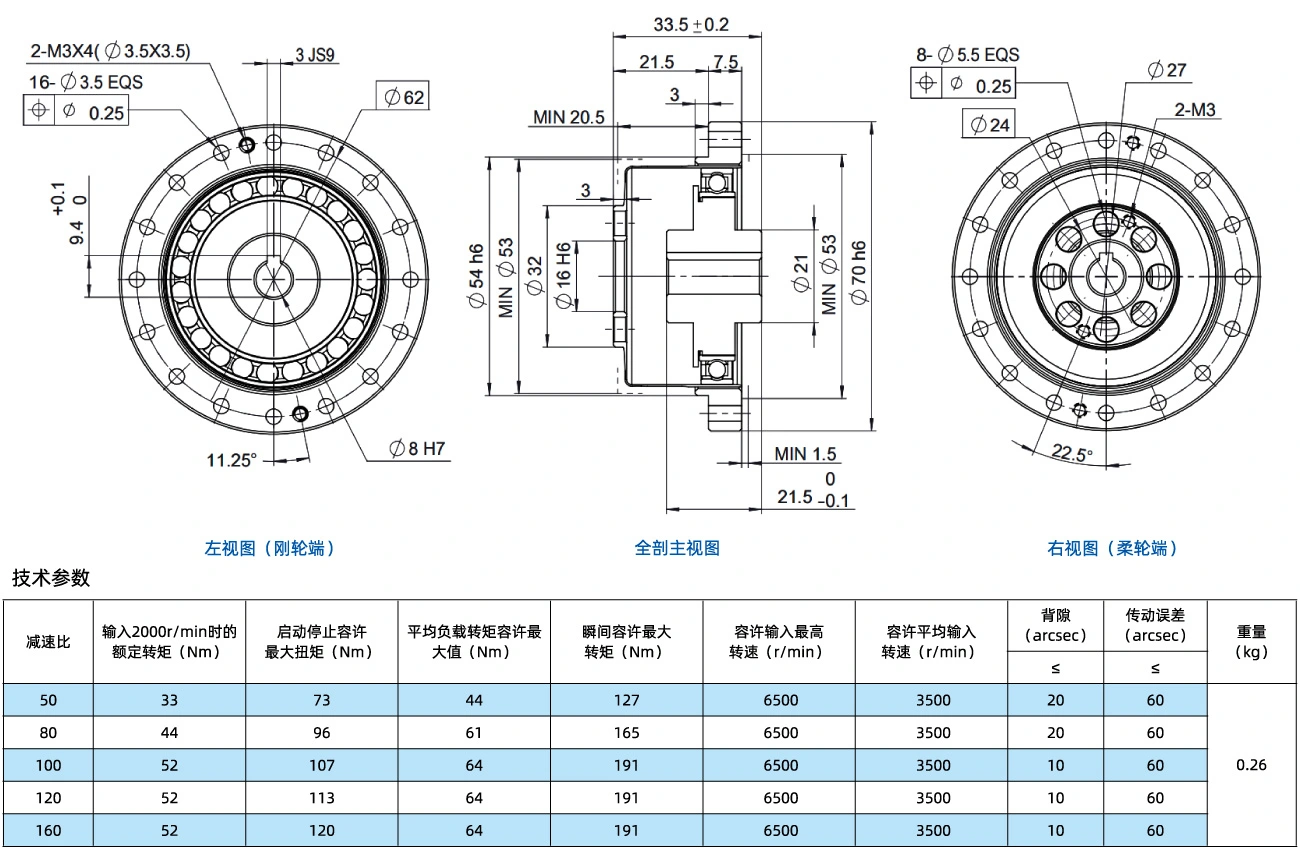
The two official performance tables publish the same values in the following frame-20 torque/backlash columns. Their masses and integration structure differ. The rated-torque column is explicitly tied to 2,000 rpm input.
On a narrow screen, swipe the table to compare all limits. Values are in Nm unless stated otherwise.
| Ratio | Rated torque 2,000 rpm input | Permissible start-stop torque | Permissible average-load torque | Momentary maximum torque | Backlash arcsec |
|---|---|---|---|---|---|
| 50 | 33 | 73 | 44 | 127 | ≤20 |
| 80 | 44 | 96 | 61 | 165 | ≤20 |
| 100 | 52 | 107 | 64 | 191 | ≤10 |
| 120 | 52 | 113 | 64 | 191 | ≤10 |
| 160 | 52 | 120 | 64 | 191 | ≤10 |
Transcribed from PMCG-I-E and PMHG-I official performance tables and checked against the frame-20 drawings. Values concern the named series/frame/ratio; do not extrapolate them to a different series or complete robot joint.
Similar ratings do not make the assemblies interchangeable.
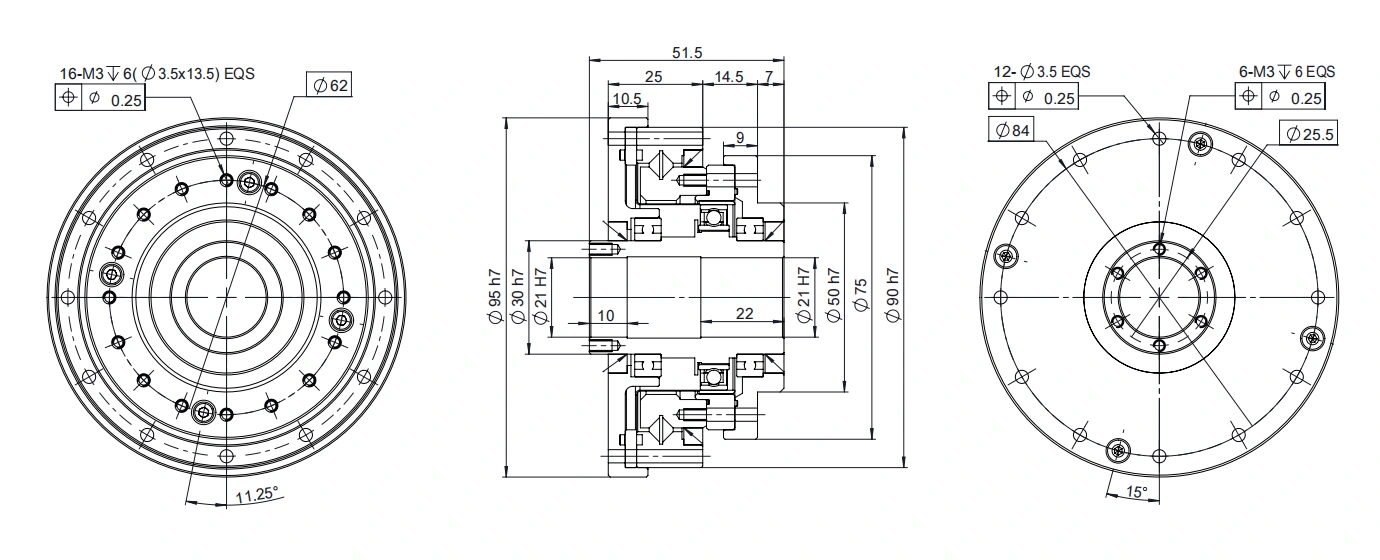
The frame-20 drawings show different axial envelopes and mounting arrangements. Compare the complete assembly from fixed structure to motor input and driven output.
Build around the component geometry
The drawing identifies circular-spline and flexspline sides and an axial dimension of 33.5 ±0.2 mm. Treat that as the shown component geometry, not a complete joint length. Confirm input fit, mounting datums and the support/sealing design before making the housing.
Check the continuous hollow route
The PMHG frame-20 section shows a 51.5 mm axial dimension and a Ø21 H7 passage at the indicated locations. Inspect every interface along the cable/air-line path. Agree the usable passage and routing clearance on the selected assembly drawing.
Precision belongs to a test condition
Arcseconds, transmission error and installed accuracy are different.
The frame-20 tables state backlash in arcseconds. At ratios 100/120/160, the published backlash is ≤10 arcsec; the transmission-error column remains ≤60 arcsec.
Keep the units explicit
60 arcsec equals 1 arcmin. Do not turn a 10-arcsecond entry into “10 arcmin,” or use the transmission-error limit as the backlash figure. Agree the applied test torque, measuring procedure, direction and configuration for each acceptance value.
Check the loaded joint
Output support, housing stiffness, coupling, encoder/control and load geometry affect installed positioning. Provide radial/axial loads, moment, payload inertia and reversing motion. Ask for selected-unit bearing and rigidity data and define the machine-level positioning test separately.
Define life and assembly conditions
Specify cycle count, torque/speed history, environment and lubrication/service expectations. For the component set, agree alignment and assembly instructions; for the hollow assembly, agree routing, sealing and support constraints. Neither headline torque nor backlash alone establishes suitability.
Precision transmission for integrated equipment.
PICEA's official company introduction identifies Shenzhen Picea Harmonic Transmission Technology in Guangming, Shenzhen, and describes precision reducers/devices, robot systems and mechatronic equipment. Its application groups include robotics, communications, semiconductor processing, medical equipment and inspection/analysis machinery.
The National Public Service Platform for Standards Information lists 深圳市杉川谐波传动科技有限公司 among the drafting organisations of the harmonic-drive-for-robots project 20211789-T-604, linked to GB/T 30819-2024. This corroborates the named organisation's standards participation; it does not certify the two units or establish compliance for a particular order.
For procurement, record the supplying legal entity, exact PMCG/PMHG code, ratio, drawing revision and delivery scope. Request the selected unit's inspection records and applicable test/assembly instructions, and agree any material, heat-treatment or traceability requirements relevant to your joint.
Send the joint architecture and motion cycle.
Identify the component or hollow assembly route so PICEA can return a configuration-specific proposal.
Save PICEA Motion to include it in your request.- Robot/axis/equipment function, payload, quantity and installation environment.
- PMCG component set or PMHG assembly; frame, ratio and complete order code.
- Input/output geometry, housing/support layout and required hollow routing.
- Torque/speed/time cycle, starts, reversals, external loads and required life.
- Backlash, transmission-error and installed-positioning acceptance conditions.
- Selected drawing, bearing/load data, lubrication/assembly instructions and inspection records.
Sources & review
Reviewed 8 October 2026. Numerical entries were read from the original official tables and drawings. Integration and acceptance questions are editorial guidance.
- PICEA · PMCG-I series / PMCG-I-E tables and drawings ↗Component scope, input connection, official series image, frame-20 performance and complete component drawing.
- PICEA · PMHG-I hollow series ↗Hollow assembled scope, internal support/enclosure, frame-20 performance, mass and outline.
- PICEA · official company introduction ↗Legal name, Guangming location, precision-transmission scope and application fields.
- PICEA · official contact location ↗Gate 3, 1 Yuyuan West Road, Yutang, Guangming, Shenzhen.
- National standards platform · harmonic-drive project ↗Named drafting organisation in 20211789-T-604, linked to GB/T 30819-2024. Organisation evidence, not product certification.
 LinkedIn
 X
 Facebook
 WhatsApp
 Telegram
 Reddit
 Email