
Begin with the drive geometry
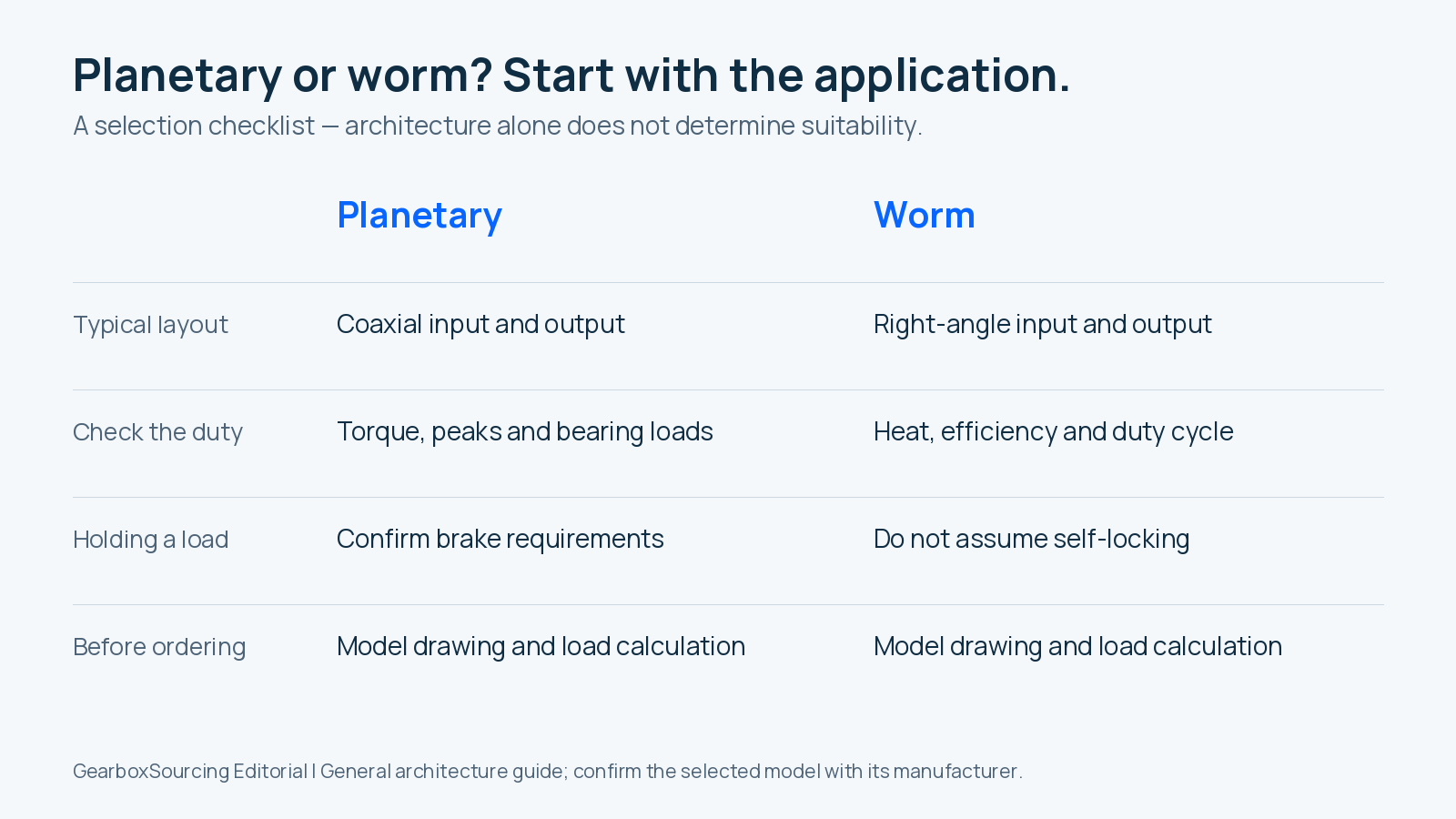
A planetary arrangement often packages the input and output on a common axis. A worm drive changes direction through a compact right-angle arrangement. This difference can decide the layout before torque becomes the limiting factor. Draw the motor, gearbox and driven shaft inside the available machine envelope. Include space for installation, coupling access and maintenance; a nominally smaller gearbox is not necessarily the smaller installed system.
Positioning and continuous running ask different questions
For a positioning axis, discuss reversal frequency, backlash, torsional stiffness and acceleration load. For a continuously running conveyor, discuss thermal capacity, lubrication and energy losses at the actual speed and load. Neither architecture is universally superior. The selection should compare complete model configurations under the same application conditions, rather than comparing an industrial worm unit with an unrelated precision planetary frame.
Use real catalog ranges as boundaries
The JIE WP page lists ratios from 10 to 60 and a family output-torque range of 6 to 6,050 Nm. Those are series limits, not evidence that every ratio is available at every torque. WANSHSIN’s WVRB data, by contrast, supplies individual frame/ratio torque rows. These two sources support different levels of comparison. Use the WP range to identify a potentially relevant family, then obtain a model-specific selection before treating it as equivalent to a documented WVRB configuration.
Do not infer a holding function
A gearbox is not automatically a safety brake. Whether a particular worm transmission can be back-driven depends on its design and operating conditions. Lubrication, wear and vibration can matter. If a load must remain in position when power is removed, specify that requirement explicitly and have the complete brake and load-holding arrangement assessed. Do not approve a suspended or hazardous load based on the word worm in a product title.
Compare the installed cost
Include motor adapters, couplings, brackets, brakes, lubricant access and commissioning in the quotation. A lower gearbox price may be offset by custom installation work or a duty limitation. Conversely, a precision planetary gearbox can be unnecessary for a simple motion that does not require tight reversal accuracy. Describe the required outcome in measurable terms so suppliers can propose an appropriate level of performance.
A fair request for alternatives
Send both suppliers the same load profile, shaft drawings, duty cycle and environment. Ask each to state efficiency and thermal assumptions, expected maintenance, allowable loads and the exact proposed model. Document why the selected architecture fits the machine. If the alternatives use different mounting orientations or output interfaces, resolve those differences before treating their prices as directly comparable.
Gearbox types and documented products in this guide
Planetary Gearboxes
- NBR090 Precision Planetary Gearbox · DESBOER / Nanpeng
- TYK / TNK Standard Spur Planetary Gearboxes · TIANYI
- High-Precision Helical Planetary Gearboxes · TIANYI
Worm Gearboxes
Continue reading
The combined limits trap in gearbox sourcing →
Planetary gearbox backlash: what ≤3 arcmin means for a servo axis →
How to verify gear heat treatment before placing a gearbox order →
 LinkedIn
 X
 Facebook
 WhatsApp
 Telegram
 Reddit
 Email