
 RV reduction for robot-joint design
Nantong Zhenkang
Specify the output arrangement and the working cycle.
Zhenkang's ZKRV-E and ZKRV-C catalogues bring ratio, output speed and torque into the same selection. They also use different ratio definitions. For a robot joint, start with the actual driven member, motor connection and load cycle, then confirm the reducer and bearing limits for that assembly.
Read the catalogue footnote first
E and C do not present the same ratio boundary.
State which member rotates and which is fixed. A nominal ratio is useful only when it describes the same motor-to-output path as the machine drawing.
ZKRV-E · carrier output
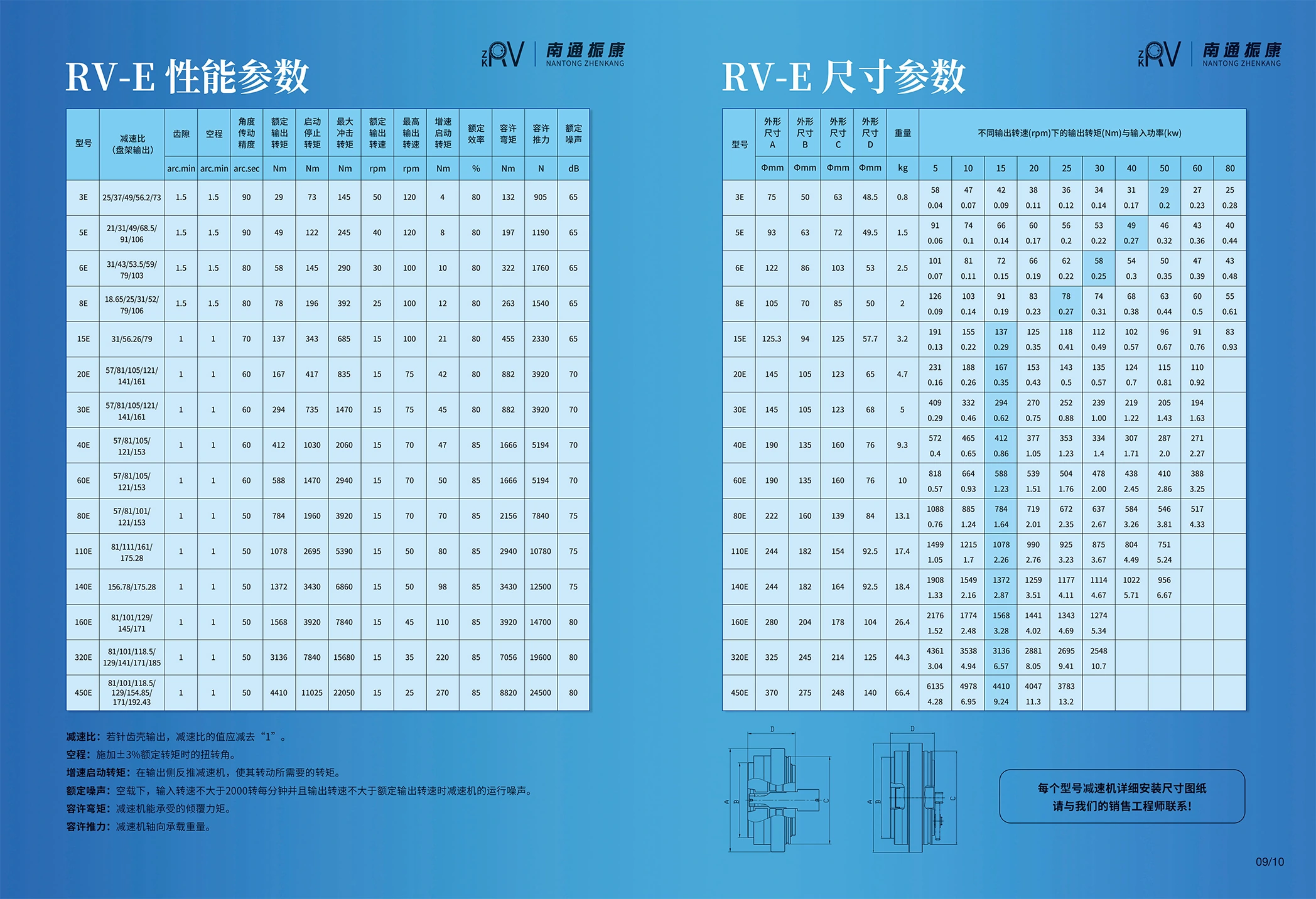
The E sheet lists ratios for carrier output. Its footnote says to subtract 1 from the listed value when the gear housing is the output member.
For 20E, the carrier-output list is 57 / 81 / 105 / 121 / 141 / 161. A listed value of 81 therefore becomes 80 under the sheet's housing-output convention. Confirm the fixed member, input gearing, direction and complete assembly drawing with the supplier.
Existing ZKRV20E specifications →ZKRV-C · reducer-body ratio
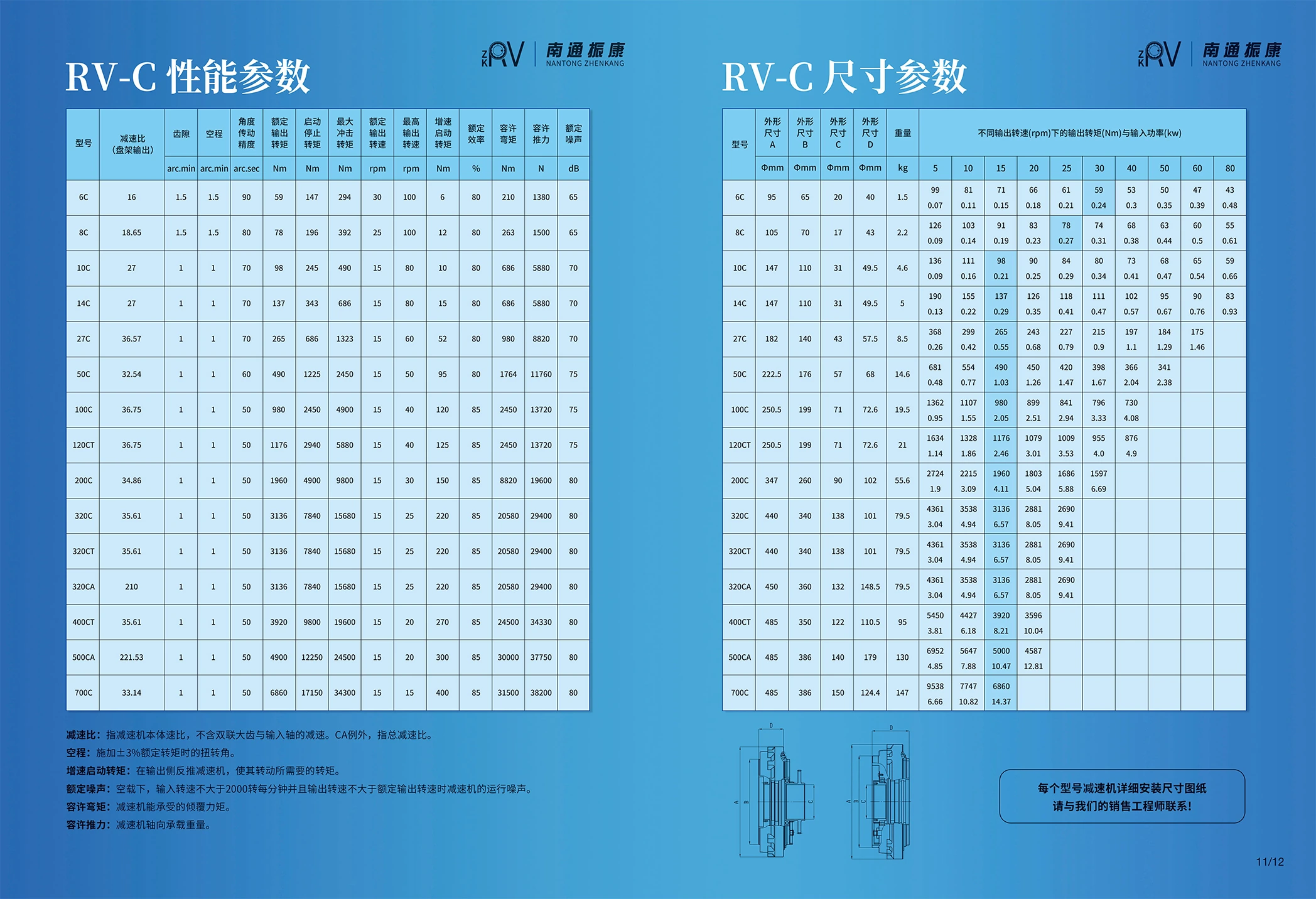
The C sheet says its ratio excludes the reduction of the external double gear and input shaft. CA models are the exception: their listed ratio is the total reduction.
The sheet lists 27C at 36.57, while 320CA is listed at a total ratio of 210. These are different models and different ratio boundaries. Request the actual input-gear arrangement and complete motor-to-output ratio before calculating joint speed or comparing quotations.
Official ZKRV-C catalogue ↗20E: separate working torque from acceleration and shock.
The supplier's E catalogue publishes 167 Nm rated output at 15 rpm for 20E, with 417 Nm start/stop and 835 Nm maximum shock in separate columns. The latter figures are not continuous operating ratings.
Published speed-dependent output torque
Original 20E row transcribed below. On a phone, read it vertically; no chart interpolation is needed.
| Output speed | Output torque |
|---|---|
| 5 rpm | 231 Nm |
| 10 rpm | 188 Nm |
| 15 rpm · rated reference | 167 Nm |
| 20 rpm | 153 Nm |
| 25 rpm | 143 Nm |
| 30 rpm | 135 Nm |
| 40 rpm | 124 Nm |
| 50 rpm | 115 Nm |
| 60 rpm | 110 Nm |
The sheet separately lists 75 rpm maximum output speed. Its 80 rpm torque cell is blank for 20E; do not extend the row beyond the stated speed limit. A cycle that repeatedly accelerates or dwells under load still needs a supplier calculation for the selected ratio, lubrication and duty.
Ask for the load-cycle calculation
For a handling arm, send the payload, tool mass, centres of gravity, joint orientation and time history of torque/speed. Include acceleration, deceleration, dwell, reversals and foreseeable abnormal loads. Compare each part of that duty with the relevant limit.
The catalogue's “reverse-drive starting torque” describes the torque needed to drive the reducer from its output side. It is a separate characteristic, not another output acceleration capacity or a safety holding rating.
Request the selected reducer's life calculation and test/acceptance conditions. Do not convert a single maximum-shock number into an allowable recurring collision or stopping duty.
Drive torque and bearing load are different checks
The output flange must carry the arm as well as turn it.
20E's catalogue lists 882 Nm allowable tilting moment and 3,920 N allowable thrust. Those are output-support quantities, separate from the 167 Nm rated drive torque.
Tool and payload overhang
Provide force directions, distances from the output support, payload/tool centres of gravity and acceleration loads. Ask the supplier to calculate the combined bearing duty for the actual robot geometry, including any additional external support.
Backlash, lost motion and transmission accuracy
The 20E row lists 1 arcmin backlash, 1 arcmin lost motion and 60 arcsec angular transmission accuracy. The footnote defines lost motion using ±3% of rated torque. Equal-looking values do not make these the same test, nor do they establish the finished robot's positioning accuracy.
Agree the measurement setup
Specify preload/load, input/output measurement arrangement, direction, temperature and the reported quantity. For a reversing servo joint, request the relevant hysteresis/lost-motion result and test method rather than only a brochure headline.
Holding and controlled stopping
Include gravity-loaded positions, power-loss behaviour and the required brake/control architecture in the machine specification. Treat reducer back-driving behaviour and brake selection as separate engineering checks.
Approve the joint assembly before purchasing the reducer.
Zhenkang's sheets include outline dimensions, but direct buyers to its sales engineers for model-specific installation drawings. Use the current selected drawing for tolerances, fasteners, pilots and the full supply boundary.
Motor, pinion and ratio
Motor model, shaft and flange; input gear/pinion and mating arrangement; fixed and rotating members; motor-to-output ratio and direction. For C, identify any external reduction and whether the selected model is CA.
Flange, housing and load
Mating drawing, joint envelope, support/fastening faces, output reaction loads and wiring/service routing. Confirm what bearings, seals and input parts are included in the quotation.
Acceptance and records
Agreed backlash/lost-motion method, speed/torque conditions, drawing revision, serial/lot traceability, lubricant and assembly instructions. Match inspection records to the delivered model and configuration.
Open the original E and C catalogue sheets
Full sheets, including footnotes, are retained below. Open an image at full size to read the Chinese original; the selected 20E values above are also available as accessible text.
Identify the RV supplier within Zhenkang's broader business.
The official company introduction traces Zhenkang's business to 1993 and describes welding wire-feed products as well as precision RV reducers. Its contact page names Nantong Zhenkang Welding Electromechanical (南通振康焊接机电有限公司) and Nantong Zhenkang Machinery (南通振康机械有限公司), with a Zhengyu, Haimen contact location.
For a reducer order, record the legal supplier, manufacturing location, RV model and included components on the quotation and contract. Welding-equipment materials or credentials should be checked for their actual scope before being applied to an RV purchase.
Independent historical context
Haimen's December 2017 proposed science-and-technology project list named 南通振康焊接机电有限公司 for an industrial-robot RV manufacturing project. This corroborates historical activity under that entity, not completion of the project or certification of a present model.
Useful evidence for today's order
Request current model drawings, material/processing records where relevant to qualification, selected-duty calculations and model-specific inspection records. Specify sampling, measurement conditions and traceability in the purchase agreement.
Send the robot joint, not just the reducer name.
Include Zhenkang in a technical enquiry with a defined output arrangement and duty.
Save Zhenkang to include it in your request.- Joint/application, quantities and the intended supplying entity.
- E/C model, fixed and rotating members, total ratio and input gearing.
- Motor details and complete input/output mating drawings.
- Payload/tool mass, geometry and torque/speed/time cycle.
- Axial/radial forces, tilting moments, support and abnormal-load assumptions.
- Selected life calculation, lubricant, assembly instructions and acceptance tests.
Sources & review
Reviewed 8 October 2026. Model figures are transcribed from the supplier's published sheets; joint-selection and acceptance questions are editorial guidance.
- Zhenkang · ZKRV-E original catalogue ↗20E ratio, speed-dependent torque, separate load limits, accuracy definitions and full sheet.
- Zhenkang · ZKRV-C original catalogue ↗Reducer-body ratio and CA exception; model-specific performance and dimensions.
- Zhenkang · company introduction ↗Business history and separate welding/RV activities.
- Zhenkang · official contact page ↗Two named entities and Zhengyu, Haimen contact location.
- Haimen · December 2017 proposed project list ↗Historical entity and RV-project context; proposal notice, not model certification or completion evidence.
 LinkedIn
 X
 Facebook
 WhatsApp
 Telegram
 Reddit
 Email