
 FLK · Feluoka industrial transmissions
Feluoka
Build the gearmotor enquiry around the output connection.
Feluoka’s K and R families serve different machine layouts. A conveyor shaft, a process coupling and a lifting-related drive each need a different installation brief. Compare the frame torque chart, output geometry and motor package together before choosing the reduction ratio.
Two separately documented architectures
Right-angle K or inline R?
Start with the space around the driven shaft and the way the machine takes torque reaction. The official pages give family-wide selection envelopes, not one unit that combines every endpoint.
K · helical-bevel
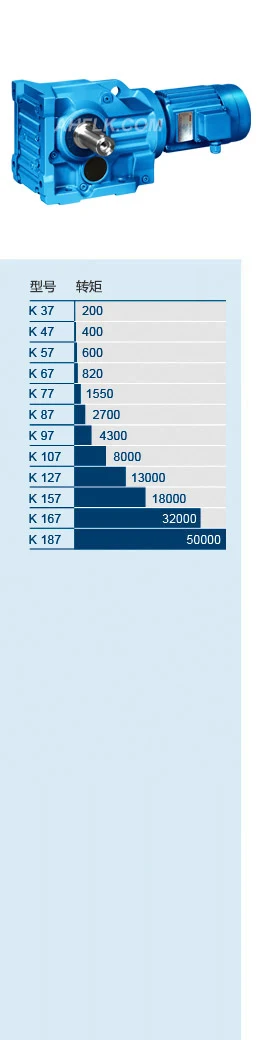
The K range changes the output direction. Feluoka lists foot and flange arrangements with either shaft or hollow output, keyless locking discs, tapered bushes for different shaft diameters and DIN 5480 splined hollow shafts.
- Reduction-ratio envelope
- 5.36–179.86
- Rated output torque envelope
- 200–50,000 Nm
- Rated power at n₁ = 1,400 rpm
- 0.12–200 kW
For shaft-mounted conveying machinery, send the driven-shaft fit and engagement length, torque-arm drawing and removal space. Confirm exactly which clamping or bushing kit comes with the unit.
Existing K product information →R · inline helical
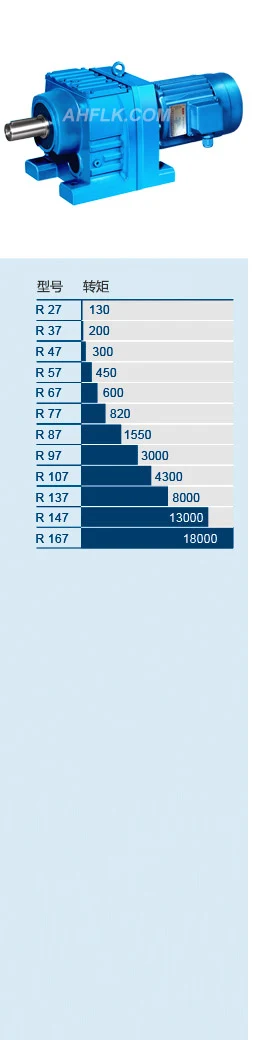
The R range places the drive in an inline arrangement. The official page names foot and flange mounting and lists motor-adapter or solid-input-shaft choices. Define coupling alignment, shaft centre height and the mating flange before comparing replacement units.
- Reduction-ratio envelope
- 3.37–229.71
- Rated output torque envelope
- 130–18,000 Nm
- Rated power at n₁ = 1,400 rpm
- 0.12–160 kW
For a mixer or process machine, identify which bearings carry the axial and radial forces. A flange mounting designation alone does not establish that the gearmotor can support an overhung process shaft.
Existing R product information →Use the frame chart to start the selection.
The original official illustrations below retain both the product photograph and the torque chart. K37 is marked 200 Nm and K187 50,000 Nm; R27 is marked 130 Nm and R167 18,000 Nm. Their intermediate frames have separate values.
A frame maximum is not a finished selection.
Ask for the ordered ratio’s mechanical and thermal ratings at the actual input speed, load spectrum and mounting orientation. The summary chart does not supply a complete ratio-by-ratio service-factor selection or bearing-load calculation.
Specify continuous torque, recurring acceleration and jam peaks separately, including duration and frequency. Include operating hours, reversing and shaft forces with their application distances. Do not select a frame solely because the largest printed number exceeds the machine’s normal running torque.
Combined reduction requires a new selection.
Both official pages list multi-stage combination options. Request the combined assembly’s drawing, rating and lubrication instructions rather than multiplying catalogue ratios and retaining the original frame’s published torque without checking.
Put the electrical and braking scope into the quotation.
The K/R pages enumerate IEC motor adapters, servo interfaces and metric or imperial solid input shafts. They also list several asynchronous, variable-frequency, brake, lifting-related and explosion-proof motor families. These are options to select for an application, not features of every delivered drive.
Motor cooling at the real operating speeds
Provide supply voltage/frequency, inverter range, acceleration ramps and low-speed running time. Feluoka lists independently powered cooling fans and thermal sensors as motor options. Ask the supplier to size cooling and winding protection for the duty, with connection diagrams and control responsibilities.
Specify the brake and backstop roles
State whether the machine requires controlled deceleration, static holding or prevention of reverse rotation. Confirm brake torque, actuation logic, wear adjustment and emergency behaviour with the machine designer. A listed backstop or brake option is not a complete lifting safety system.
Agree encoder interface and wiring
The official options include open-collector, voltage, complementary and line-driver encoder outputs. Provide the controller’s required signal type, supply, connector and pulse count. Request the motor/encoder arrangement and wiring sheet as part of the package.
Identify the applicable protection requirements
Where a motor is proposed for a hazardous area, give the actual area classification and applicable approval requirements. Obtain documents for the exact motor and assembly. A catalogue reference to an explosion-proof motor family does not establish certification of an arbitrary gearbox package.
Manufacture and contracting
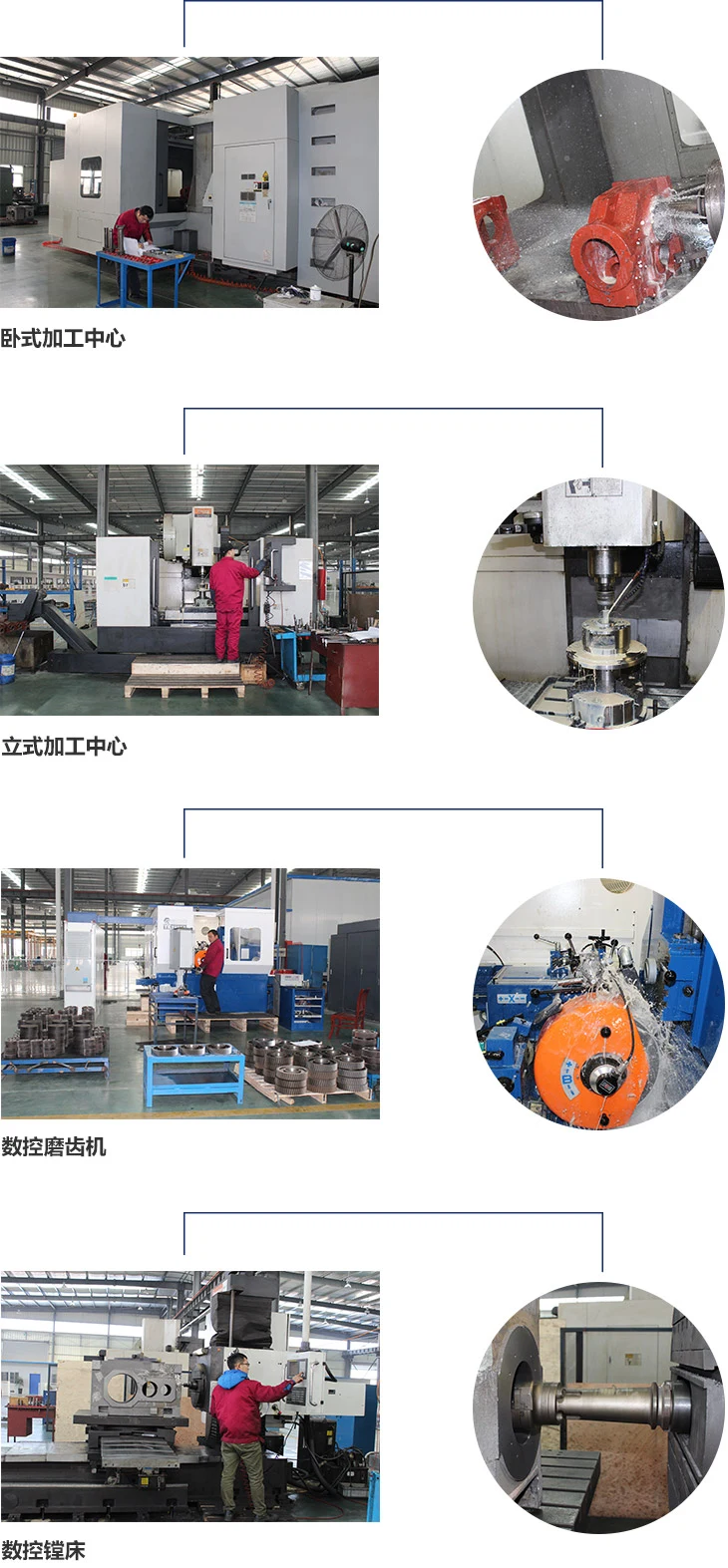
Connect the process photographs to the ordered parts.
The official equipment page illustrates horizontal and vertical machining centres, CNC gear grinding and CNC turning. For the selected gearbox, agree housing and gear materials, heat-treatment requirements, dimensional checks, assembly traceability and the delivered test record.
The company’s portfolio includes wire-drawing and hoist-specific drives as well as general gearmotors. Use the dedicated family and duty sheet when the machine depends on tension, repeated starts or lifting-related controls; do not substitute a general K/R envelope for an application-specific design.
A June 2023 Lu’an government employment bulletin independently names the Chinese legal company and lists assembly roles. It gives a historical Shouchun Middle Road work address, whereas the current official contact page gives Shouchun East Road. Confirm the present manufacturing/shipping address and exact contracting entity on the quotation. The employment notice is identity context, not a product certification.
Prepare a gearmotor package enquiry.
Send the mechanical installation and electrical package together so proposals cover the same drive.
- Machine, quantity, required output speed and load cycle.
- Input motor/speed, desired ratio and running hours.
- Driven-shaft or coupling drawing, output form and torque reaction.
- Radial/axial loads, positions and mounting orientation.
- Ambient conditions, cooling and lubricant/service access.
- Supply, inverter, thermal sensors, fan, brake and encoder scope.
- Selected frame/ratio drawing, acceptance records and spare-parts list.
 LinkedIn
 X
 Facebook
 WhatsApp
 Telegram
 Reddit
 Email