
 Xinghai · Pingyang industrial reducers
Xinghai
Choose the drive around the load and its installation.
Xinghai’s FF parallel-shaft gearmotor and BW/XW cycloidal families use different reduction mechanisms and mounting guidance. For a conveyor, process machine or retrofit, compare how the load reaches the output shaft, the required speed and the support arrangement before choosing a frame.
Parallel-shaft helical installation
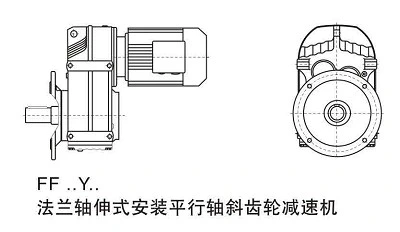
FF is the flange/solid-shaft arrangement shown.
The official FF page describes a modular parallel-shaft range and a ribbed cast-iron housing, with alloy-steel gears, carburising/quenching and finish grinding as supplier descriptions. Its drawings distinguish the installation geometry; these process descriptions are not a serial-specific hardness or acceptance report.
The frame table groups F / FA / FF / FAF / FAZ. For size 37, it lists 0.18–3 kW input power, 3.81–128.51 ratio and 200 Nm permissible torque. Size 117 lists 7.5–90 kW, 4.63–172.17 and 12,000 Nm. These are frame-column selection envelopes, not one operating point.
The page’s introductory summary gives 0.12–90 kW, output speeds 0.1–752 rpm and torque up to 12,000 Nm, while its broader frame table includes size 127 at 11–200 kW and 18,000 Nm. Use the requested frame/arrangement’s current selection sheet to resolve the scope rather than merging the two summaries into a universal FF rating.
Existing FF product information →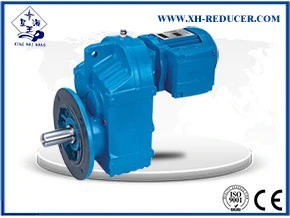
Cycloidal pinwheel reduction
Read the operating conditions before asking for a ratio.
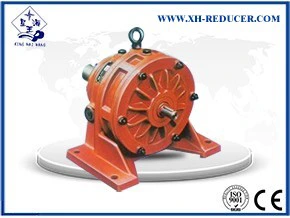
The official BW/XW page describes planetary-principle cycloidal pin-tooth meshing. It lists single-stage ratios up to 87 and double-stage ratios up to 7,569. Those stage envelopes should not be combined with one-stage efficiency or treated as a torque rating.
Existing cycloidal product information →Continuous duty and both directions
The supplier permits continuous operation and forward/reverse running for this range. Define actual hours, reversals, acceleration and overload events so the ordered frame, motor and coupling are checked against the machine cycle.
1,500 rpm nominal; different guidance above 18.5 kW
The page gives 1,500 rpm as rated input speed. For input power above 18.5 kW it recommends a six-pole motor at 960 rpm. State the proposed motor speed and power rather than selecting by output ratio alone.
Horizontal mounting needs lubrication planning
The supplier describes horizontal installation and generally a horizontal inclination below 15°. Beyond that it calls for additional measures to maintain lubrication and prevent leakage. Ask for the approved mounting drawing, fill quantity and level-check procedure for the real orientation.
Large radial and axial forces need other measures
The page says the output shaft must not carry large radial or axial loads without additional measures. Provide the pulley, sprocket, coupling or process-shaft loads and their distances. Agree external bearings or another support arrangement; do not infer an allowable force from a torque headline.
Match the family to the machine problem.
The company lists metallurgy, materials handling, food/beverage, logistics and environmental equipment among its application sectors. Use the operating case below to ask for a specific selection, rather than treating the sector list as evidence that any model fits.
A conveyor with a shaft-mounted drive
Define output speed under load, continuous and startup torque, reversals and jam conditions. Show the shaft fit, torque reaction, pulley/sprocket forces and maintenance access. Compare the selected parallel-shaft arrangement’s bearings and thermal rating with the required duty.
A continuously running process drive
Provide ambient conditions, speed, running hours, peak duration and lubrication access. For a cycloidal selection, agree input speed and shaft support first. If the process produces thrust or bending, show how the machine’s own bearings carry it.
An extrusion or screw-jack application
Xinghai lists dedicated extrusion-reducer and screw-jack families. Ask for that family’s catalogue and load/interface calculation. A general FF or BW selection does not establish extrusion thrust capacity or a screw-jack system’s lifting/holding function.
Agree what will be delivered and measured.
Request the exact motor/reducer code, mounting drawing, lubricant, nameplate data and acceptance test scope. Where materials, gear hardening or noise matter, specify the required report and its measurement conditions. The official site publishes quality-system and Zhejiang Manufacturing certificate news; obtain the current certificate and scope for the contracting company or product where the order requires it.
The source product images contain the supplier’s own marks. Keeping the original image does not mean GearboxSourcing independently certifies those marks. Establish the selected model’s documents in the quotation and inspection plan.
A Wenzhou government notice dated 2017 lists Zhejiang Xinghai in Pingyang under trademark recognition for reducer goods (class 7, registration 3048226). It is historical identity/brand context and does not establish a current model’s mechanical or thermal rating.
For overseas supply, agree export packaging, motor electrical standard, drawing revision, spare parts and who handles commissioning/service questions. Ask for a usable manual for the delivered mounting position and a parts list that identifies the assembly after installation.
Prepare a load-and-installation enquiry.
Describe what the machine actually does, then ask for a frame-level selection and drawing.
- Machine, quantity and family/installation preference.
- Motor input speed/power and required loaded output speed.
- Continuous, startup, reverse and jam torque with durations.
- Shaft forces, load positions and external-bearing arrangement.
- Mounting angle, foundation, lubrication and service access.
- Selected frame/ratio, mating drawing and electrical package.
- Current documents, acceptance measurements and export/service scope.
 LinkedIn
 X
 Facebook
 WhatsApp
 Telegram
 Reddit
 Email