
 Tunsing · Zhejiang Gear Reducer Motor
Tunsing
Read the complete ordering code before replacing a gearmotor.
Tunsing’s official catalogue separates inline R gearmotors from right-angle K units, then defines shafts, motor interfaces, mounting positions and terminal-box orientation. For a new installation or replacement, the frame number is only the beginning of the specification.
Original illustrated selection sheets
Which shaft and motor arrangement does the machine need?
The drawings below are the supplier’s own catalogue illustrations. They distinguish mechanical arrangements within a family; a short name such as “R37” or “K37” does not specify all of them.
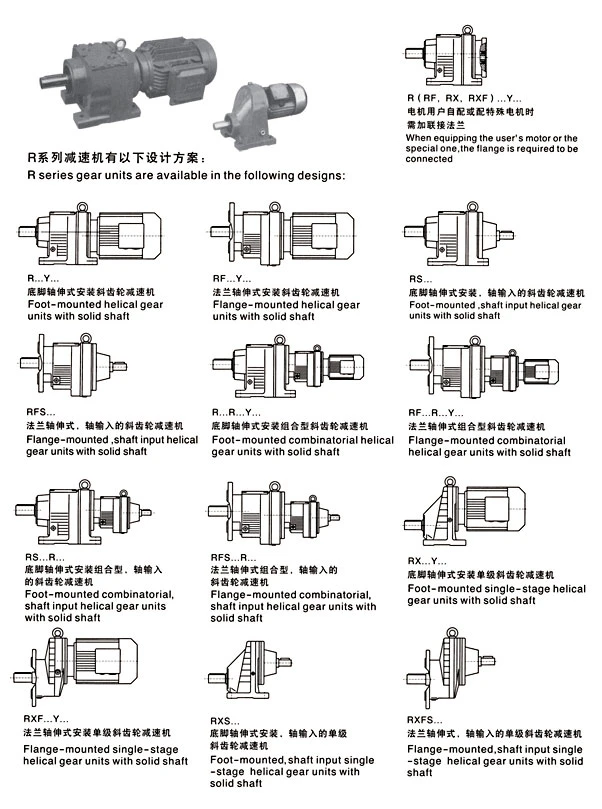
R / RF / RS / RFS and RX variants
R and RF show solid-shaft output with foot or flange mounting. RS and RFS add shaft input. Combined assemblies are illustrated separately; RX/RXF single-stage units also have separate performance tables. Keep these distinctions when requesting a model or replacing an existing nameplate.
Existing R product information →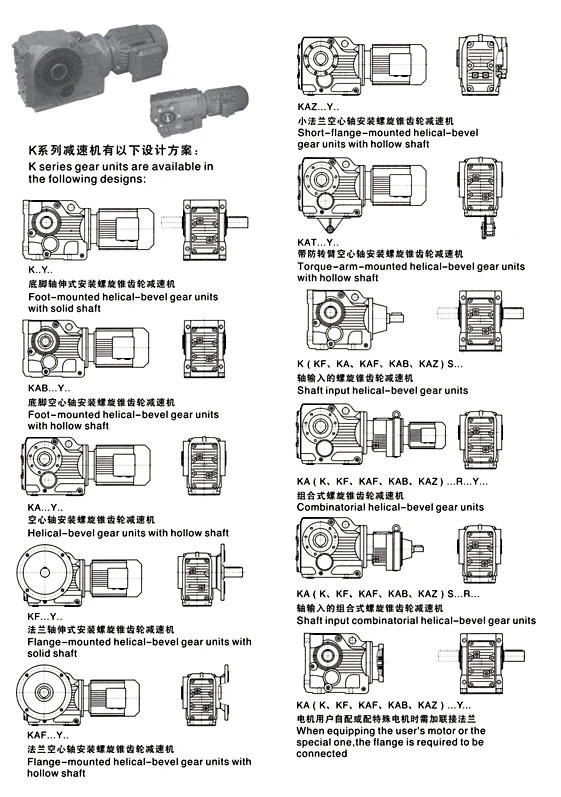
K / KA / KF / KAF / KAZ / KAT / KAB
The K sheet distinguishes solid shafts, hollow shafts, flanges, short flanges, torque arms and foot-mounted hollow-output versions. Give the machine’s driven-shaft drawing and retention/reaction arrangement. A hollow bore or matching nominal ratio is not enough to confirm that the installation fits.
Existing K product information →Frame 37: similar torque, different selection envelopes.
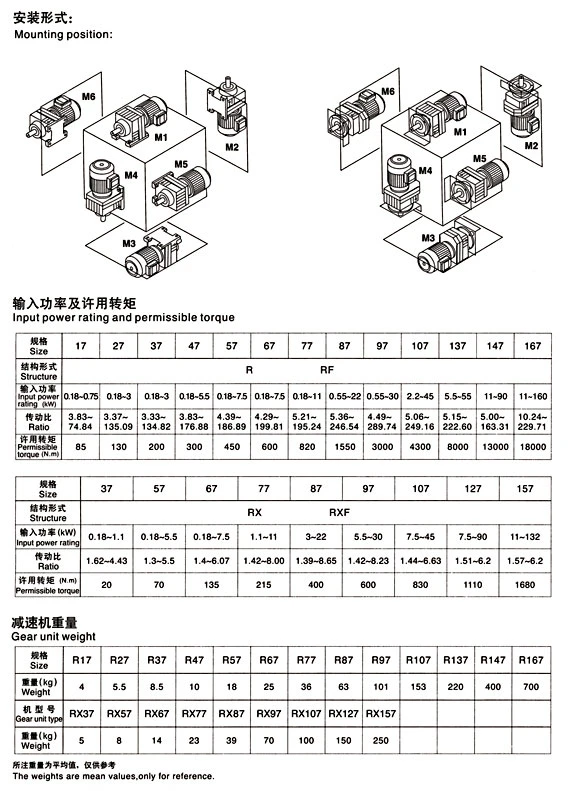
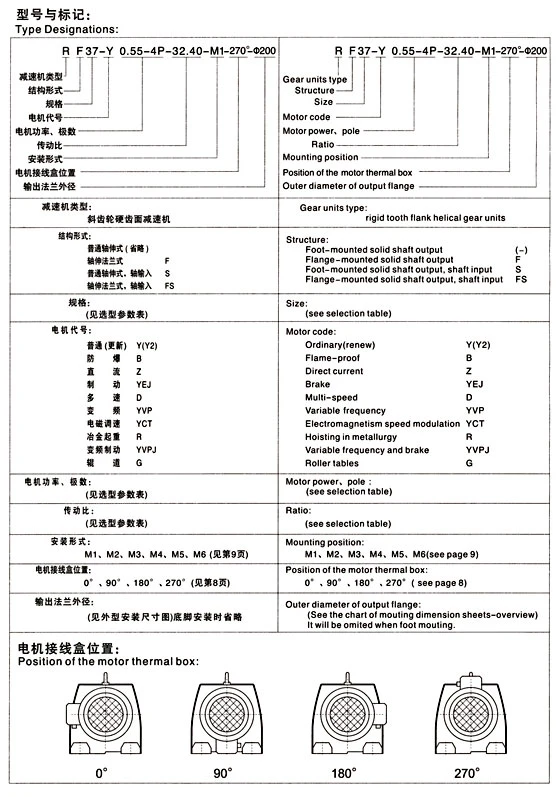
These values come from the frame-37 columns in the official “input power and permissible torque” tables. Each column is a range of selections, not one motor that supplies every endpoint simultaneously.
R / RF · size 37
- Listed input power
- 0.18–3 kW
- Listed ratio range
- 3.33–134.82
- Permissible torque
- 200 Nm
- Reference R37 unit weight
- 8.5 kg
RX37 is a separate single-stage entry: 0.18–1.1 kW, ratio 1.62–4.43 and permissible torque 20 Nm. Do not carry the 200 Nm R37 value into an RX37 selection.
K / KA / KF / KAF / KAZ / KAT / KAB · size 37
- Listed input power
- 0.18–3.0 kW
- Listed ratio range
- 5.36–106.38
- Permissible torque
- 200 Nm
- Reference K37 unit weight
- 11 kg
The catalogue explicitly treats weights as reference values. Request the delivered assembly’s dimensions, motor mass and load-bearing arrangement, especially where a shaft-mounted drive is supported by the machine.
Ordering-code walkthrough
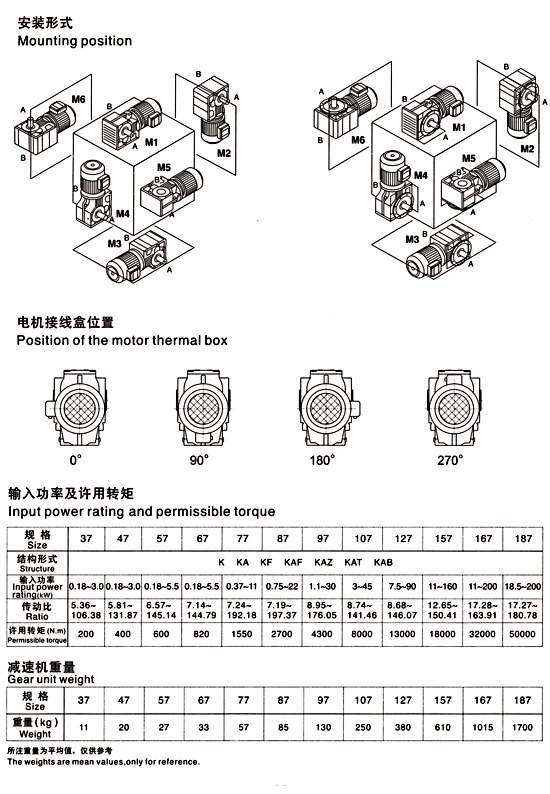
RF37-Y 0.55-4P-32.40-M1-270°-Φ200.
This is the R catalogue’s printed example. Read it as a flange arrangement, size 37, Y motor, 0.55 kW/four poles, ratio 32.40, M1 mounting, 270° motor terminal-box position and a 200 mm output-flange outer diameter. It is an example code, not a promised in-stock assembly.
For a replacement, copy the full installed nameplate, photograph the motor/gearbox orientation and send a measured mating drawing. Terminal-box position can determine cable access; the flange’s outer diameter alone does not define its pilot, bolt circle or tolerances.
The K code has additional output-side and rotation descriptors. Its printed example uses M1, an A-side output and CW rotation viewed from the output shaft. Confirm the viewing convention and direction with the machine designer rather than assuming motor direction labels describe the driven mechanism.
Specify the motor function.
The code key includes ordinary, brake, multi-speed, variable-frequency, lifting-related and roller-table motor designations. Provide the required electrical duty and control interface. Ask for the selected motor’s actual nameplate and protection documents; historical company awards or certification dates do not substitute for current product documents.
Mounting position changes the lubrication discussion.
Tunsing’s oil tables distinguish M1–M6 positions and different output arrangements. Changing orientation during installation therefore needs more than rotating the housing.
R37 versus RF37
The R37 oil table lists 0.3 / 1 litres for M1 and 0.9 litres for M2. RF37 lists 0.4 / 1 litres for M1 and 1 litre for M2. The sheet’s footnote associates the larger quantity with combined multi-stage arrangements. Confirm the ordered build, lubricant and level-check procedure.
K37 versus hollow-output KA37
The K…/KAB… table lists 0.5 litres at M1 and 1 litre at M2 for size 37. The KA…/KAF…/KAZ… table lists 0.5 litres at M1 and 1.3 litres at M2. Specify the complete mounting and output code so the supplier provides the correct filling and breather instructions.
For a conveyor, include belt/pulley forces, the overhung distance and stop/reverse cycle. For a process drive, give continuous load and thermal conditions. Agree the actual input speed, service factor and bearing-load selection rather than treating the frame summary as an unconditional machine rating.
Send the nameplate and installation drawing.
A precise retrofit brief helps the supplier check both the electrical package and the mechanical interface.
- New drive or replacement; complete existing ordering code and photos.
- Input speed, output speed, torque and repeated load/stop cycle.
- R/RX or K family, shaft/adapter and output arrangement.
- Mounting M1–M6, output side and required direction/viewing convention.
- Shaft or flange mating drawing and external forces.
- Motor supply, inverter/brake/feedback and terminal-box access.
- Lubrication instructions, drawing revision and delivery/test records.
 LinkedIn
 X
 Facebook
 WhatsApp
 Telegram
 Reddit
 Email