
 Wind energy & mobile machinery
WEILI Transmission
Follow the load from the machine.
A winch lifts through a drum and rope system. A slewing reducer turns a platform through a pinion and ring gear. WEILI supplies planetary drives for both routes, alongside wind-energy transmissions. Start with the load path and duty, then select the gear unit, motor, brake and interfaces.
Begin at the driven equipment
Two mechanisms. Two different selection briefs.
The official pages describe multi-stage planetary transmission, integrated parking brakes and adaptation to fixed- or variable-displacement hydraulic motors. The driven interfaces and machine load calculations remain distinct.
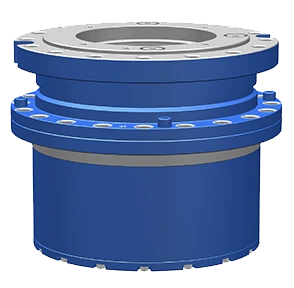
Winch · drum and reeving
The reducer turns the drum. Rope wound on the drum and reeved through the pulley system raises or lowers the crane hook. Define line pull, drum radius at each rope layer, reeving efficiency and speed; hook load alone is not the gearbox output torque.
- Working and maximum line pull, rope specification and layer count.
- Drum geometry, bearing arrangement and drive connection.
- Lift/lower cycle, starts, holding periods and exceptional stops.
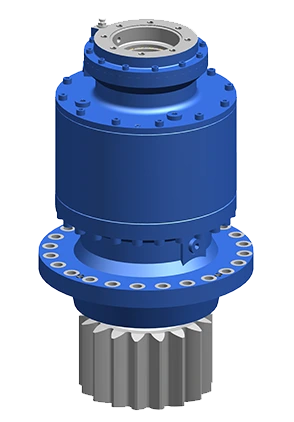
Slewing · pinion and ring gear
The output gear meshes with the machine's ring gear to turn the platform. WEILI names rotary drilling rigs, concrete pump trucks, aerial work platforms, excavators and cranes. Identify the pinion/ring geometry and supported platform rather than treating the reducer as the slewing bearing.
- Rotating inertia, acceleration, duty and loaded platform positions.
- Ring/pinion teeth, module, contact geometry and mesh setting.
- External loads, overhang and the separate bearing/support arrangement.
Published ranges define families, not one combined operating point.
WEILI's web pages provide the following family envelopes. The maximum-torque and ratio endpoints must not be combined into a single model specification without the matching selection data.
Winch reducer family
- Published ratio range
- i = 26–420
- Published maximum-output-torque range
- 7.5–325 kNm
Equivalent torque range: 7,500–325,000 Nm. Each value is part of the published family envelope, not an established continuous rating for every ratio or motor.
Slewing reducer family
- Published ratio range
- i = 16–760
- Published maximum-output-torque range
- 7–620 kNm
Equivalent torque range: 7,000–620,000 Nm. Obtain the selected frame, ratio, output pinion and duty-specific rating before calculating the machine drive.
Control the machine, not just the gear ratio
Parking brakes and hydraulic motors need their own conditions.
Both official family descriptions state an integrated parking brake and compatibility with different fixed- or variable-displacement motor series.
Brake selection
Agree required holding load, brake reference location, release pressure/control and failure-state behavior. A parking-brake description does not establish a dynamic stopping-energy capacity. Identify the machine's stopping and lowering-control functions and who supplies them.
Motor and circuit selection
Send pressure, flow, return/case-drain conditions, oil temperature, filtration and the planned control scheme. For variable displacement, specify the range and control behavior. Confirm the motor mounting/interface and complete assembly envelope on the chosen drawing.
Installation and commissioning
Define direction of rotation from a named viewing end, valve sequence, brake release, load checks and safe test conditions. For replacements, compare the entire installed unit, interfaces and controls rather than only a nominal ratio.
Wind-turbine drives are a separate engineering route.
WEILI's official business overview distinguishes yaw and pitch reducers, main wind-turbine speed-increasing gearboxes, and yaw/pitch motors. These perform different functions and belong to different supply scopes.
Yaw and pitch drive
Identify the turbine/platform revision, driven ring or blade interface, load spectrum, motor/brake/control boundary, environment and maintenance requirements. Agree model-specific tooth/contact details, backlash, lubrication and inspection with the supplier.
Main transmission
Specify the turbine architecture, power/speed duty and system interfaces. The mobile-machinery winch/slewing family ranges above are not wind-turbine main-gearbox ratings and should not enter that selection calculation.
For an OEM programme or retrofit, obtain the approved interface drawings and selection/validation responsibilities. Separate a gearbox-only quotation from an integrated drivetrain or motor/drive package.
Turn manufacturing capability into order-specific inspection.

WEILI's company page states a group origin in 2003 and describes materials testing using spectroscopy and metallographic equipment, product test benches, and manufacturing/project information systems. For a purchase, use those capabilities to define the evidence required for your assembly.
- Material and heat-treatment records tied to the ordered components.
- Inspection dimensions and pinion/drum interface drawing revisions.
- Torque/speed/load test conditions and agreed acceptance limits.
- Brake and hydraulic assembly checks, leakage and temperature criteria.
- Traceability, maintenance documents, spares and service scope.
The 2025 annual report, corrected and published in June 2026, identifies the legal entity, English company name, stock code, Yinchuan address and www.weili.com website. Identify the actual contracting/manufacturing entity on the order; a group introduction or stock listing is not product certification.
Start with the driven machine.
Give WEILI a load path, duty and interface drawing so the response can identify a complete drive configuration.
Save WEILI Transmission to include it in your request.- Winch, slew or wind-turbine function; quantity, location and environment.
- Drum/rope/reeving geometry or pinion/ring/platform interface.
- Torque, speed and time/load spectrum with starts and exceptional events.
- Motor/hydraulic circuit or electrical motor/control requirements.
- Holding and stopping functions, brake scope and commissioning conditions.
- Selected model, rating envelope, assembly drawing and inspection/traceability records.
Sources & review
Reviewed 8 October 2026. Family envelopes and product descriptions come from WEILI. Machine selection and inspection questions are editorial guidance.
- WEILI · official winch reducer page ↗Drum/rope function, planetary structure, parking brake, hydraulic motor options, ratio/maximum-torque ranges and product illustration.
- WEILI · official slewing reducer page ↗Pinion/ring connection, machine applications, independent family envelope and product illustration.
- WEILI · business and locations overview ↗Wind-energy and construction-machinery product groups; Yinchuan headquarters.
- WEILI · company and manufacturing introduction ↗Stated group history, materials/product testing capability and facility photograph.
- WEILI · corrected 2025 annual report ↗Page 7: legal/English company name, stock code 300904, registered/office address and website. Corporate identity evidence, not a product approval.
 LinkedIn
 X
 Facebook
 WhatsApp
 Telegram
 Reddit
 Email