
 Servo & stepper transmission
Xiaolan Transmission
Fit the planetary reducer to your axis.
Xiaolan's NB090 and NF090 helical planetary designs address frequent starts, reversals and repeat positioning. Their mechanical form and motor adapter still need to match the actual rack drive, rotary table, arm or cam. Choose the interface and load conditions alongside the precision grade.
Two published 090 designs
Square or round body: start with the installed envelope.
Both official pages describe a helical, double-supported cage structure and a square flange. The NB090 page specifies a square body; the NF090 page specifies a round body. Compare the actual outline and output interface rather than treating the shared “090” size label as interchangeability.
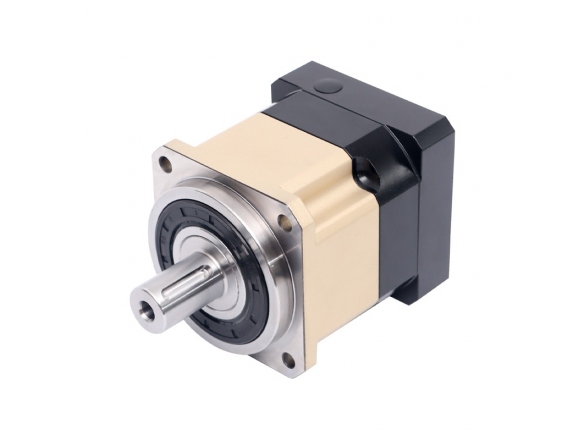
NB090 · square body
The NB route uses the square-body form shown on its official page. Send your available envelope, locating surfaces, mounting holes and output-shaft connection. For a replacement, compare the full assembly with the attached motor.
NB090 specifications in this directory →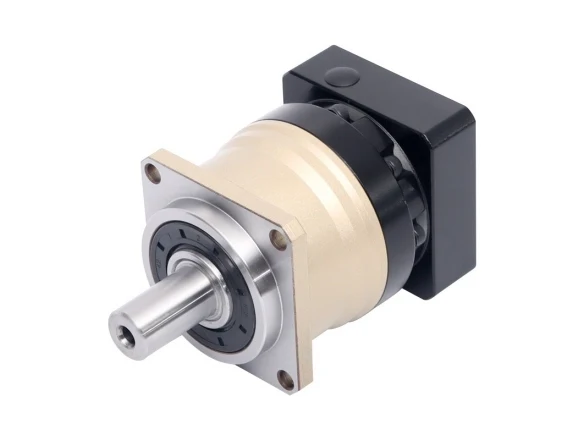
NF090 · round body
The NF route has a round body behind the square flange. Check surrounding equipment clearance and adapter length against a selected drawing. Its similar advertised precision grades do not establish the same torque, ratio or shaft geometry.
Official NF090 product page ↗These are two distinct official product presentations. Specify the NB or NF series on the enquiry and obtain its selected ratio, motor adapter and output drawing.
Agree the ordered grade
Backlash is a configuration requirement.
The NB090 and NF090 pages publish three return-clearance grades. Put the chosen grade and its acceptance conditions into the order specification.
| Official grade description | Published return clearance |
|---|---|
| Standard | ≤5 arcmin |
| Precision | ≤3 arcmin |
| Ultra precision | ≤1 arcmin |
Supplier-published limits on the two cited product pages. Specify the frame, ratio, stage count and grade together, then agree the applied test torque, direction-change procedure and measuring method.
Ask for the selected unit's measured result and test conditions. The gearbox return clearance is only one contributor to installed positioning: motor control, coupling, rack/pinion or table connection, structural compliance and external loads must also meet the axis requirement.
If repeat positioning is the aim, define the loaded direction-change and positioning test on the assembled machine. Keep the reducer's angular test separate from the machine's linear or rotary positioning acceptance.
Send the motor model, not just “750 W servo.”
The NB090/NF090 text lists 400 W, 750 W, 850 W and 1 kW servo motors, together with an 86-size stepper, as adaptation routes. A power label or motor family name does not specify the mechanical connection.
Identify the exact interface
- Motor manufacturer and complete model/order code.
- Flange pilot diameter/depth and bolt pattern.
- Shaft diameter, length, key or plain clamping surface.
- Motor connector location and access for assembly.
Confirm the working configuration
- Required output speed, working/peak torque and cycle.
- Ratio and stage count with the selected torque rating.
- Acceleration, reversals, motor inertia and payload.
- Adapter/clamp arrangement and approved tolerances.
The cited web pages focus on structure, precision grades and motor adaptation. Obtain the matching ratio/torque/input-speed table and assembly drawing for your selected unit before choosing the motor or replacing an installed drive.
For clamped motor input, agree the fitting and tightening procedure, permitted shaft dimensions and coupling access. Install to the unit's instructions and check alignment; an adapter that bolts to the motor does not, by itself, establish an acceptable drive assembly.
Different driven mechanisms create different checks.
The two helical 090 pages name racks, rotary tables, arms and cams as application routes. Use the mechanism to define the enquiry rather than sending a generic “high precision gearbox” request.
Rack-and-pinion drive
Provide linear force/speed, pinion geometry, carriage mass, acceleration and travel cycle. Show the force direction and pinion overhang relative to the output support. Agree the permissible output loads and the rack/pinion contribution to positioning.
Rotary table
Show rotating inertia, payload/center of gravity, index angles, acceleration and dwell. Identify table support bearings and any moment transferred to the reducer. Agree indexing and holding requirements at the loaded operating point.
Arm or cantilever mechanism
Give the load geometry, lever arms and worst-case positions. Separate motion torque from output bending/radial/axial loads. Define exceptional stop events and whether the reducer or external bearings support the mechanism.
Cam or repeated reversal
Send torque and speed over the full motion cycle, including short-duration peaks and reversals. Specify cycles per hour, run/rest time and ambient conditions. Agree the selected unit's thermal and service-life calculation and acceptance test.
Planetary transmission and application matching.
The official site identifies Xiaolan Transmission Machinery (Shanghai) and describes helical and spur planetary development, with precision planetary work beginning in 2009. It lists gear shaping/hobbing and machining equipment, and application fields including CNC machinery, printing/packaging, textile and conveying equipment.
Its product navigation distinguishes the 诺宏 and AOPTE planetary groups alongside hollow rotary platforms, right-angle drives, worm reducers and lifting equipment. Name the intended series and responsible supply scope on the enquiry and purchase order; do not assume all these architectures have the same ratings or interfaces.
For a purchase, agree the supplied legal entity, selected model/ratio/grade, drawing revision and inspection record. If material or heat treatment is critical, request unit-linked gear material, treatment and hardness-test documentation. The public manufacturing description is a starting point for those order requirements.
Bring the axis drawing and duty together.
A useful enquiry identifies NB/NF form, motor interface, selected precision and the mechanism's loads.
Save Xiaolan Transmission to include it in your request.- Machine/axis function, quantity, destination and installation environment.
- NB/NF or other named series; ratio, stage count and required backlash grade.
- Exact servo/stepper code and flange/shaft drawing with available envelope.
- Output speed/torque/time cycle, acceleration, reversals and exceptional stops.
- Rack/pinion, rotary payload, arm or cam geometry and external output loads.
- Selected unit's torque/speed/load table, drawing revision and agreed motion/material tests.
Sources & review
Reviewed 8 October 2026. Structural descriptions and grade limits are supplier-published. Load and integration questions are editorial guidance.
- Xiaolan · official NB090 product page ↗Square body, square flange, double-support helical structure, backlash grades, motor/application descriptions and NB image.
- Xiaolan · official NF090 product page ↗Round body, square flange, published grades, motor/application descriptions and NF image.
- Xiaolan · company overview and product navigation ↗Company name/contact location, stated development history, machining descriptions and distinct product groups.
 LinkedIn
 X
 Facebook
 WhatsApp
 Telegram
 Reddit
 Email